

Strategic workforce planning isn’t just a nice-to-have. It’s a necessity if you want to achieve your business goals.
Imagine your business is past the day-to-day grind. You can breathe and finally start planning instead of reacting to what’s in front of you today. The goals you have developed are lofty but doable with the right team. What’s the next step to set yourself and your team up to achieve the company’s goals?
The first question you need to ask:
Does my team have the capabilities to accomplish the goals?
Your business strategy and goals may define where the organization wants to go, but your people will ultimately determine whether you can get there. Business planning and workforce planning shouldn’t happen separately.
That is where workforce forecasting, skills-gap analysis and workforce planning work together. Think of them as three connected questions:
- Workforce forecasting: What people and capabilities will we need in the future?
- Skills-gap analysis: What capabilities are we missing compared with what we need?
- Workforce planning: What are we going to do about it?
Together, they create a roadmap to move your organization from where it is today to where you want it to be tomorrow.
Start with Where You Want to Go
Before evaluating your workforce, start with the business.
What does your organization want to accomplish over the next one to three years? Instead of looking at your current organizational chart and asking what positions you need to fill, look at your strategic goals and ask what those goals will require from your workforce.
Does your company want to increase revenue by 25%, introduce AI into its operations, and expand into two new markets?
All of those goals have workforce implications.
Growth may require additional capacity. AI adoption may require technical skills the organization doesn’t currently have. Expansion may require additional managers.
impactAction
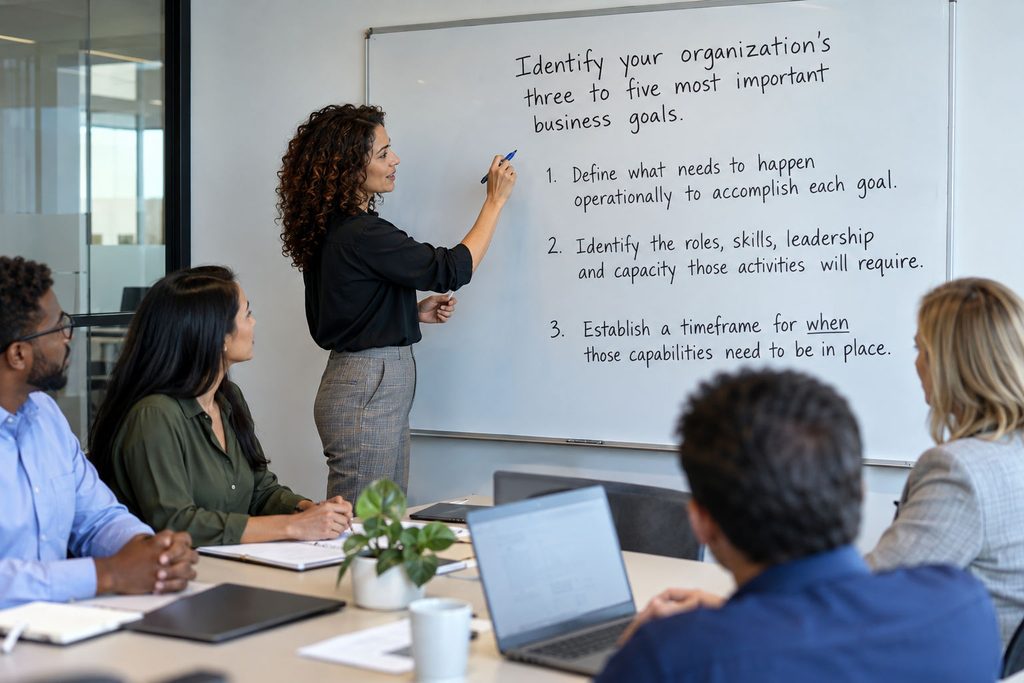
- Identify your organization’s three to five most important business goals.
- Define what needs to happen operationally to accomplish each goal.
- Identify the roles, skills, leadership and capacity those activities will require.
- Establish a timeframe for when those capabilities need to be in place.
Now you have a destination. The next question is what it will take to reach it.
Determine What You’ll Need
This is where you translate business strategy into workforce needs.
Workforce forecasting asks: “What people and capabilities will we need in the future?”
Consider both quantity and capability. How many employees will you need? What expertise will they need? What leadership capacity will be required? Will existing jobs change because of technology, automation, or new ways of working?
Imagine that a company’s growth projections indicate that within two years it will need:
- 10 additional employees
- Greater AI and data expertise
- Two additional managers
- Increased project-management capacity
That forecast provides something much more useful than simply saying, “We’re going to need more people.” It defines the workforce the company will need to execute its strategy.
impactAction:
- Review projected growth, revenue, customers, products, or services.
- Determine where increased business activity will create additional workload.
- Identify roles likely to grow, shrink or significantly change.
- Consider new skills that technology, market changes or customer expectations will require.
- Estimate future leadership and management needs.
- Put a timeframe around each anticipated workforce need.
Don’t limit forecasting to increasing your employee headcount. The next section focuses on identifying skills gaps within your current employees. You may already have the talent, but they are sitting in a different position. Remember, additional employees won’t solve a problem if they don’t bring the capabilities the business needs.
Assess Where You Are Today
Once you know what the future requires, compare that future state with your current workforce. Strategic workforce planning includes a skills-gap analysis to answer the following questions:
“What capabilities are we missing compared with what we need?”
Using our earlier example, a skills gap analysis may reveal that the organization already has sufficient project-management capability. However, it has limited AI expertise and only one employee who is currently prepared to move into management.
This is an important distinction. A workforce forecast identifies a future need. It doesn’t automatically mean you need to hire.
The forecast identified four potential needs. The skills-gap analysis narrowed the actual gaps.
This step can prevent unnecessary hiring while also uncovering internal talent that might otherwise be overlooked.
impactAction:
- Inventory the skills and experience already within your organization.
- Review employee performance, certifications, experience and demonstrated capabilities.
- Talk with managers about employees who have skills that may not be fully utilized in their current roles.
- Identify high-potential employees who could take on greater responsibility.
- Compare existing capabilities with your workforce forecast.
- Categorize gaps by urgency: need now, need soon and need later.
This exercise may also reveal that the issue isn’t always a lack of talent. Sometimes the right capability exists in the organization but sits in the wrong role, department or structure.
Close the Gaps: Build a Workforce Plan
Once you understand the difference between what you have and what you’ll need, you can determine how to close the gap.
Workforce planning asks: “What are we going to do about it?”
Hiring is one solution, but it isn’t the only one.
Your organization may decide to:
- Hire externally for specialized expertise.
- Upskill or reskill current employees.
- Develop a management track with current employees
- Restructure roles or teams.
- Automate lower-value or repetitive work.
- Outsource functions that don’t need to reside internally.
- Redeploy employees whose existing capabilities can meet needs elsewhere in the business.
Return to our example. Instead of hiring 10 employees- an AI specialist, two managers, and additional project managers- the workforce plan might look very different.
The company could hire selectively for AI expertise, train existing employees to use new technology, develop two high-potential employees for future management positions, and reallocate existing project-management resources.
Suddenly, the workforce strategy is much more targeted and much more cost-effective
impactAction:
For each identified gap, ask:
- Can we build it? Can an existing employee be trained or developed?
- Can we buy it? Do we need to recruit someone who already has the expertise?
- Can we borrow it? Could a consultant, contractor or outsourced provider meet the need?
- Can we redesign it? Could technology, automation or restructuring change the work itself?
- When do we need it? Work backward from the business goal to determine when recruiting, training or development needs to begin.
Assign ownership and timelines to those actions so the workforce plan becomes something the organization executes and not simply a document it creates and then ignores or forgets about.
Business Strategy Is Also a People Strategy
Strategic workforce planning isn’t just about predicting how many employees you’ll need. It’s about making sure your organization has the right people, with the right capabilities, at the right time to accomplish its goals.
Start with where you want the business to go. Forecast what that future will require. Compare those needs with the talent you already have. Then build a deliberate plan for closing the gaps.
The earlier you make those connections, the more options you have. And you will have more time to develop and implement your strategic workforce plan.
With that new found time, you will have time to develop an employee instead of discovering a critical skills shortage when you’re ready to launch a new initiative. Instead of scrambling to hire managers after rapid growth, you can begin building your leadership pipeline now. You can spend that time determining whether restructuring, technology, or outsourcing is a better solution.
Ultimately, you’ll have time to plan.
And remember,
The question isn’t,
“Do we have enough people?”
It’s:
“Do we have the workforce with the capabilities to achieve our goals?”
When your workforce strategy answers that question, your people aren’t simply supporting the business plan; they become part of how you achieve it. Your team is your business.
Connect with impactHR we’ll help you develop a workforce strategy that aligns with your business goals.
