


What is your compensation strategy? As the cost of consumable goods increases, employees are paying attention to what you are telling them about their compensation. Should they expect a merit increase or a cost-of-living adjustment? Or both?
Employees are also hearing about inflation, cost-of-living adjustments, and rising wages in the news, which can influence what they expect from their employer.
For employers, that makes it increasingly important to have a clear strategy for how and why you give pay increases.
According to data reported by SHRM, employers provided an average total salary increase of 3.5% in 2025, including merit increases, promotions, cost-of-living adjustments, and other increases. Merit increases alone averaged 3.2%.
Salary budgets have remained relatively stable since then. Actual U.S. salary increase budgets averaged 3.5% in 2026, and current projections put 2027 budgets at approximately 3.4%.
But those percentages only tell part of the story. Employers also need to determine what they are rewarding or adjusting for when they increase an employee’s pay.
A cost-of-living adjustment and a merit increase serve two very different purposes. Treating them the same will create confusion for employees and undermine the compensation strategy.
Build a Compensation Strategy Before the Conversation
A thoughtful compensation strategy helps employees understand how their pay is determined while giving employers a more consistent, equitable, and financially sustainable approach to rewarding their workforce.
The worst time to decide what a raise means is when you’re sitting down to tell an employee what they’re getting.
Before the next compensation cycle, employers should determine:
- What are we trying to accomplish? Decide whether increases are addressing performance, inflation, market competitiveness, promotions, or another business need.
- What data will guide our decisions? Review reliable compensation benchmarks, economic indicators, geographic differences, and internal pay equity.
- How will merit be differentiated? Establish meaningful performance criteria and guide managers on translating performance into recommendations.
- How will we communicate increases? Make sure employees understand what portion of an increase reflects merit, COLA, promotion, or a market adjustment.
- Can we sustain our approach? Build increases into compensation planning rather than making reactive decisions based on employee expectations or economic headlines.
Ultimately, the goal is to determine how much employees receive in compensation increases and why.
Merit Increase vs Cost of Living: What’s the Difference?
A cost-of-living adjustment (COLA) is intended to help address changes in purchasing power caused by inflation or changes in the cost of living. It is not generally tied to how well an individual employee performed.
A merit increase, on the other hand, recognizes an employee’s individual performance and contribution to the organization.
Think about the distinction this way:
COLA asks: Has the economic environment changed enough that we need to reconsider employees’ pay?
Merit asks: How has this employee performed, contributed and developed?
Employers may also need to consider a third question: Has the market value of this particular job changed? That is where a market adjustment may be appropriate.
These increases are not interchangeable. An employee could warrant a market adjustment without having exceptional performance. A high performer could deserve a merit increase even when inflation is low. And a company could provide COLA broadly to all employees, or to those in specific geographic areas.
Separate Merit Increases from COLA or Market
One of the most important ways an employer can distinguish COLA from a merit increase is through communication and the timing of the increase. If you provide COLA, it should be done completely separately from the merit increase. Employees must understand why an increase is occurring.
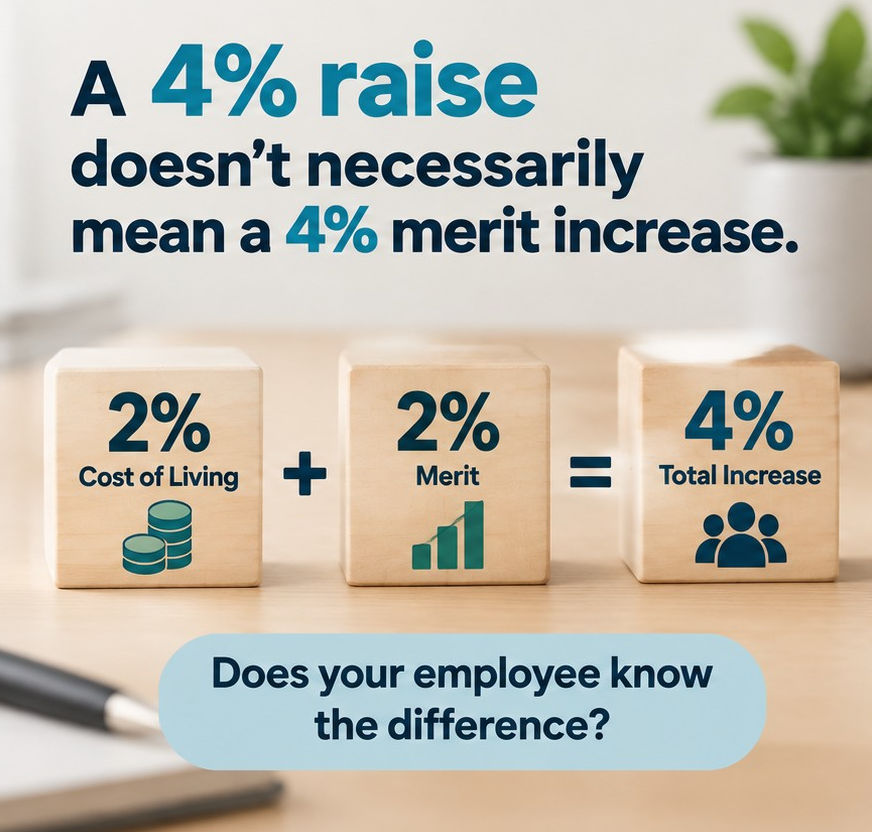
For example, if employees receive one 4% increase during their annual performance review, they may reasonably assume the entire increase reflects their performance. If the employer intended 2% as a cost-of-living adjustment and 2% as merit, that distinction has been lost.
Consider providing and communicating the increases separately:
Cost-of-living adjustment: 2%
Performance-based merit increase: 2%
Total increase to base salary: 4%
When feasible, employers can reinforce the distinction by providing COLA and merit adjustments at different points in the year. This makes it easier for employees to understand what each increase represents.
Separating the two also protects the value of your performance-management process. If your organization says it rewards performance, employees need to see a meaningful connection between performance and compensation.
Avoid these Pitfalls with Merit Increases
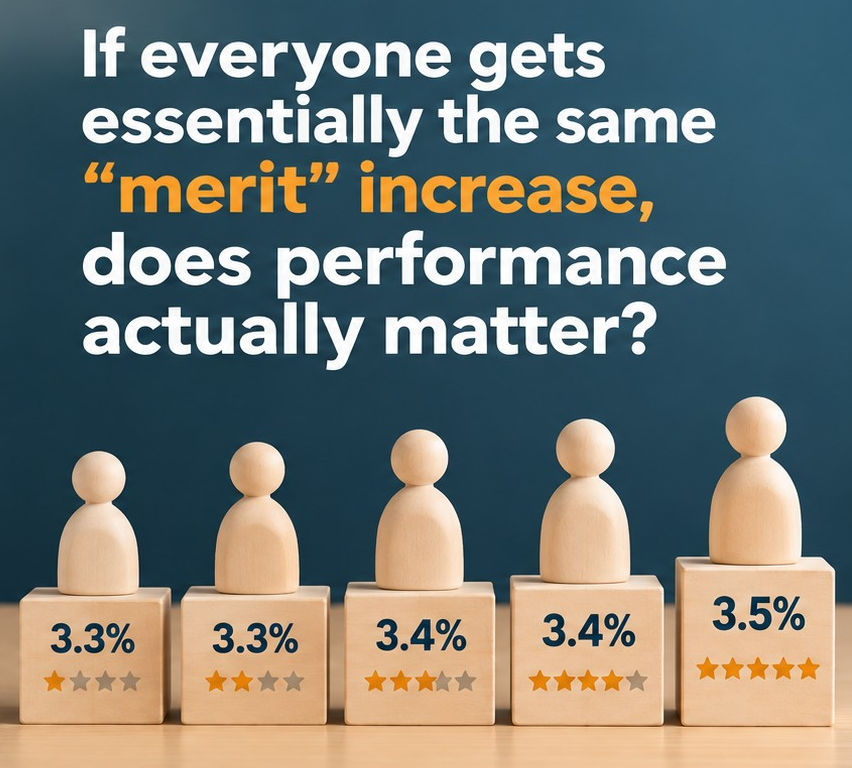
One of the biggest challenges is providing essentially the same increase to everyone while calling it “merit.” If a top performer receives 3.5% and an employee who meets only basic expectations receives 3.3%, employees may reasonably question whether performance actually matters.
In 2025, Mercer data reported by SHRM showed greater differentiation among organizations using five performance ratings: top performers received average increases of 5.6%, compared with 3.3% for employees in the middle performance category.
Before merit increase conversations are had between managers and employees, human resources should review ratings across departments, look for inconsistencies and make sure managers can support their recommendations with documented performance.
Financially Sustainable Compensation Decisions
Another common mistake is creating an expectation that a COLA or merit increase will occur every year regardless of business conditions.
Compensation decisions need to be financially sustainable.
If business conditions mean the company can’t provide its typical increase, or can’t provide an increase at all, communicate that clearly. Silence or vague explanations can create more frustration than a straightforward conversation.
Explain what the organization considered, what it can provide and, when possible, whether other forms of total reward can help bridge the gap.
Flexible or remote work arrangements, additional paid time off, flexible scheduling, professional development opportunities, incentive compensation or other benefits may have meaningful value to employees even when the salary budget is limited.
Don’t present these options as equivalent to higher pay. Instead, they are part of the organization’s broader total reward strategy.
Make Compensation Part of Your Business Strategy
Whether an increase is tied to performance, cost of living or the market, compensation decisions should be intentional. A well-developed compensation strategy gives you a framework for making those decisions consistently while balancing employee expectations, market competitiveness, and what your organization can financially sustain.
Are your compensation practices competitive and strategic?
impactHR can conduct a comprehensive compensation analysis to evaluate your current salaries, pay ranges, internal equity and market competitiveness. From there, we can help you develop a compensation plan that defines how your organization approaches merit increases, market adjustments, salary ranges and overall pay decisions.
Connect with impactHR; we’re ready to help you take the guesswork out of your compensation strategy.
